 Satdobato, Lalitpur, Nepal
  [email protected]
- +977-01 5915470

Policy dialogue on “Road Safety Curriculum in Schools, Colleges, and Universities in Nepal”
Policy dialogue on “Road Safety Curriculum in Schools, Colleges, and Universities in Nepal”
December 9, 2025
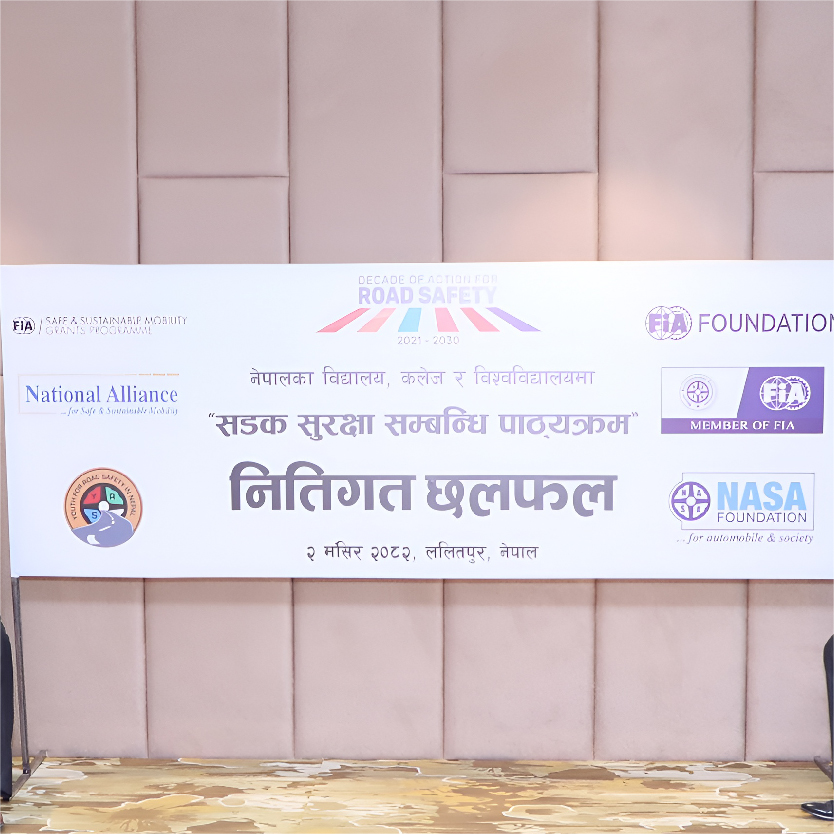
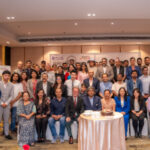
A one-day policy dialogue on “Road Safety Curriculum in Schools, Colleges, and Universities in Nepal” has been successfully concluded in Kathmandu. This event marked one of Nepal’s first comprehensive educational discussions focusing on sustainable roads and safe transportation. The dialogue featured multidimensional presentations and deliberations on the curriculum-development process in Nepal, the role of road safety within sustainable development, and the responsibilities of federal, provincial, and local governments.
Conducted under Nepal Automobiles’ Association (NASA Nepal) ’s campaign “Voice of Youth for Safe and Sustainable Mobility,” supported by the FIA Safe and Sustainable Mobility Grant Program and the FIA Foundation, the event saw participation from more than three dozen stakeholders comprising representatives from the Curriculum Development Centre, the Ministry of Physical Infrastructure and Transport, and the Department of Roads, along with mayors, deputy mayors, and senior officials from Dhulikhel, Budhanilkantha, Kageshwari Manohara, and Changunarayan municipalities. Principals from various schools and colleges, university faculty members, journalists, victim families, experts, and rights activists were also present.
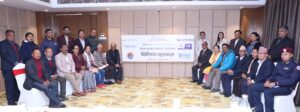
Senior leaders from key educational organizations—including HISAN, PABSON, school operators, police officials, as well as individuals affiliated with NASA Foundation, Youth for Road Safety Nepal, Nepal Parliamentary Secretariat, National Alliance for Safe and Sustainable Mobility Nepal, Cycle Culture Movement Nepal, and Tribhuvan University—actively participated in the dialogue.
Given that road accidents are the eighth leading cause of premature death globally but the leading cause of death in Nepal, participants emphasized the need for early intervention through school- and university-level education. Key recommendations included strengthening intergovernmental coordination, incorporating practical and technical training in addition to theoretical knowledge, updating and systematizing the existing partial curriculum, and implementing road-safety education across all school levels nationwide.
Chaired by NASA Nepal President Dasarath Risal, the program featured presentations by road-safety PhD scholar Dr. Bhagwati Sedhai, Curriculum Development Centre Director Dinanath Gautam, Nepal Police Highway Safety and Traffic Directorate Superintendent Saroj Giri, Youth for Road Safety Nepal representative Kiran Dhital, and coordinator of Voice of Youth for Safe and Sustainable Mobility campaign Subas Bhattarai.
Prominent speakers—including Parliamentary Secretariat Secretary Dr. Rojnath Pandey, Dhulikhel Mayor Ashok Byanju, Budhanilkantha Mayor Mitharam Adhikari, Deputy Director General of Department of Roads Er. Prabhat Kumar Jha, Kageshwari Manohara Deputy Mayor Shanta Thapa, and National Alliance for Safe and Sustainable Mobility’s Prof. Dr. Rohit Kumar Pokharel—shared their perspectives and experiences.
Road-accident survivors and advocates—journalist Rabin Thapaliya, Dr. Taralal Shrestha, school principal Manju Chitrakar, HISAN Vice-President Ramhari Silwal, and activist Saroj Khanal—remarked that such policy-level discourse could serve as a milestone for enhancing road safety in Nepal.
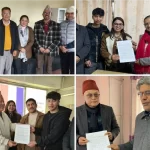
The program, coordinated by NASA Nepal Executive Director Govinda Bhattarai, also announced the formation of a task force comprising Dr. Bhagwati Sedhai, Manju Chitrakar, and Kamala Kshetri. The task force has been entrusted with drafting, lobbying for, and facilitating the implementation of a road safety curriculum from the primary level to the university level.